Category: Blog

Open perspectief op beleggen. 2025Q2 update

In dit blog wil ik een overzicht geven van de rendementen op brede beleggingscategorieen over de afgelopen vijf jaar. De lijst wordt aangevoerd door Bitcoin en defensieaandelen met een gemiddeld rendement over de afgelopen vijf jaar van resp. 62.2% en 22.8%. Dat zijn spectaculaire resultaten. Een belegging van 1.000 Euro in Bitcoin zou na vijf jaar ruim 11.200 Euro waarde zijn, en hetzelfde bedrag in defensie aandelen 2.700 Euro. De Bitcoin heeft daarbij ook een extreem hoog risico, gemeten als de standaarddeviatie (Std) van de maandelijks rendementen. In de praktijk komt het erop neer dat het moment waarop je begint of stopt met beleggen een sterke impact zal hebben op het resultaat.

Verder valt op dat Europese landen over de afgelopen 12 maanden uitstekende rendementen hebben laten zijn, veel beter dan Noord Amerika. De onzekerheid die Donald Trump heeft veroorzaakt met zijn enigmatische tarieven beleid pakt vooralsnog goed uit voor Europese aandelen. Helaas laat Nederland teleurstellende resultaten zien. Verder zijn de rendementen van de niet-Westerse aandelen (Azie, Brics, Latijns Amerika, Pacific) beperkt.
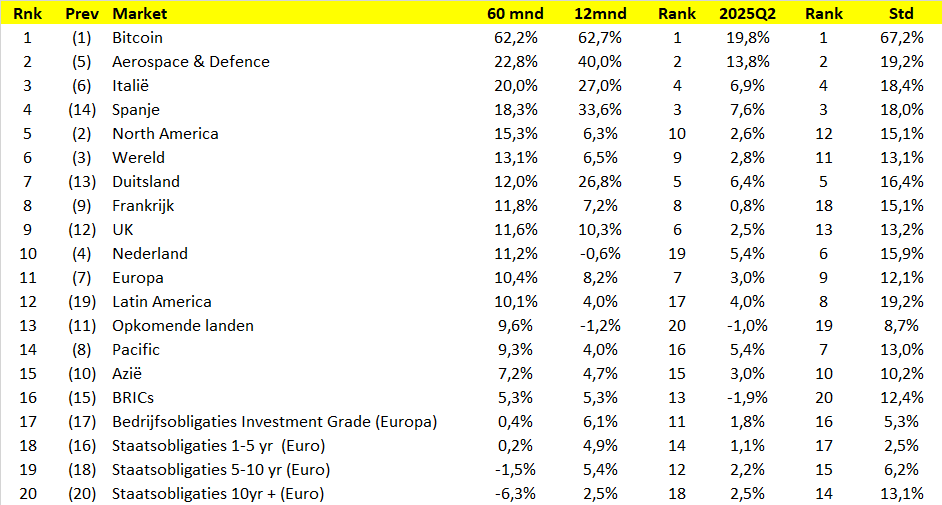
Dit overzicht is gebaseerd op gemiddelden van index rendementen uit verschillende landen en regios berekend over de verschillende aanbiederes van een index. Verder staan in dit overzicht de rendementen van obligaties vermeld. Tot slot heb ik ook de Bitcoin en defensie aandelen toegevoegd. Het doel van deze lijst is niet om de beste regios voor het komende jaar te selecteren, maar om trends in brede markten te laten zien. Een verstandige beleggingsportefeuille is doorgaans gebaseerd op een mix van al deze markten. Het zal daarom niet verbazen dat de wereld index nooit bovenaan staat, maar altijd ergens boven het midden van de ranglijst.

Regional Investing

Regional Investing

Auke Plantinga

In the past two decade we have experienced a dramatic change in the way that households invest. Many have decided to disengage from stocks market investing and switch to a standard savings account, mutual funds or index funds. Obviously, the global financial crisis of 2007/2008 had a lot to do with this too. In 2020 and 2021, the COVID19 crisis kept a lot people at home, re-engaging them with stock markets. Some of them started chasing stocks such as GameStop motivated by boredom or protest against the evil of hedge funds.

Unfortunately, this leads to a disconnect between the typical citizen and the financial markets. Few people understand the true contribution of financial markts to society. Financial markets are a means of allocating investments to valuable projects, facilitating cooperation between people with small savings how do not know each other. Many people lost their trust in financial markets, mostly as a result of the many scandals in the previous two decades.

One reason for losing trust is the strong focus on returns in combination with the anonymity of investments. Money itself doesn’t create wellbeing, but the way it is spend may  have a big impact. As an example, most of us would appreciate a carefully selected personal birthday gift over a check. This also applies to investing. Probably the only benefits of investing in the MSCI Global Large Cap Equity Index are its financial returns and perhaps the idea that you have not been ripped off by a greedy asset manager. There will be little affection in your decision to buy this index.

Globalization provided the world with economic growth, but made it difficult for the individual to understand and believe in the system that generates wealth. It has become abstract and far away, resulting in rising populism and focusing on the home country. Donald Trump got elected on his theme ‘Make America great again’, yellow vests crowd the streets of France, the people of Great Britain opted for Brexit, and so on. 

It is important that humans can effectively engage and connect with the systems that support their lives, and one of these systems is the financial system. For this reason I have a very modest proposal that may be helpful. I propose that people can choose an investment portfolio of firms that is active in the local neighbourhood, province, or city. In particular, I pro`pose that such a portfolio would allocate its investments according to the number of people working in the region for the particular firm. Essentially, you invest in firms that employ your neighbour.

I tried this for firms in the provinces of Groningen, Friesland, and Drenthe in the northern part of the Netherlands. First of all, there are more than 100 companies active in this region that are listed on the stock market. That is sufficient for creating a well diversified portfolio. There are many firms listed on a foreign exchange, and so perhaps the most surprising results is that this regionally oriented portfolio is actually an internationally diversified portfolio. In addition to this, the branches of these firms provide over 20,000 jobs, which provided an additional argument for citizins of the northern part of the Netherlands to invest in this portfolio: Invest in the job of your neighbour! There is no reason why this would not work for any region elsewhere in the world.